

Could one cataract operation replace years of glaucoma drops?
Friday 13 March 2026Every evening, there is the same small test.
Find the bottle. Tilt back your head. Hold the eye open. Get the drop in. Then do it again tomorrow.
If you live with glaucoma, or love someone who does, you know the burden is not just the diagnosis. It is that protecting sight can depend on getting a fiddly little routine right every single day.
This week, eye specialists were given a glimpse of a different future. On 9 March 2026, SpyGlass Pharma reported topline 12-month results for a replacement lens designed for people who already need cataract surgery. But this is not just a lens. It is a lens that slowly releases glaucoma medicine inside the eye.
That is why this story matters. The problem with glaucoma drops is not that they do not work. The problem is that life does not always co-operate.
Hands are not always steady. Eyes water. Bottles run out. A dose is missed. Another goes down the cheek. And because glaucoma often gives no warning in everyday life, the reward for doing everything right can feel invisible.
The development making glaucoma specialists pay attention
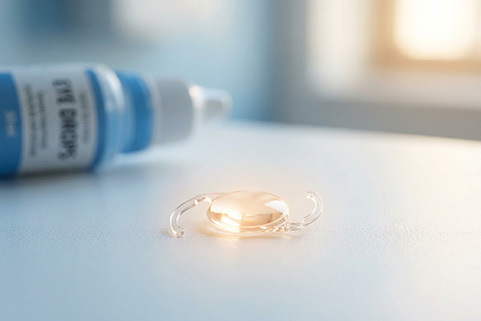
The new device is called the BIM-IOL System. In simple terms, it is a replacement lens used in routine cataract surgery with tiny drug pads attached to it. Once implanted, it is designed to release bimatoprost, a familiar glaucoma medicine, inside the eye over multiple years.
In other words, the treatment could sit inside the lens instead of on your bedside table.
This latest trial involved 104 people with open-angle glaucoma or ocular hypertension who were also having cataract surgery. Some received the drug-releasing lens. Others received a standard lens plus timolol eye drops.
The results in plain English
At 12 months, the new lens lowered eye pressure by a similar amount to the standard treatment.
But the figure that really matters to patients is not the pressure graph. It is the drop bottle.
According to the company, 98% of evaluable patients in one dose group and 96% in the other were still free from topical pressure-lowering drops at the 12-month mark.
That is the point where this stops sounding like clever medical engineering and starts sounding relevant to real life.
Because what many people want is not a more interesting device. They want fewer things to remember. Fewer chances to get it wrong. Fewer evenings when protecting their sight depends on a tiny bottle and a steady hand.
The visual results were also reassuring. In the patients assessed, everyone reached 20/32 or better best-corrected distance vision after surgery, and the company said no serious ocular side effects were seen in the trial.
Why this matters in real life
Glaucoma treatment is full of small burdens that add up:
- the daily drop you nearly forget when you are tired
- the second bottle because one medicine is not enough
- the uncertainty over whether the drop actually landed
- the quiet worry that missing doses could matter, even if nothing feels different today
That is why a treatment built into cataract surgery is such an interesting idea. It does not ask patients to be more disciplined. It tries to remove the need for discipline in the first place.
For the right patient, that could be a very different kind of freedom.
What this means for you right now
Not that glaucoma drops are about to disappear.
This treatment is not yet approved for routine use. It is still going through trials, and larger Phase 3 studies are already under way.
It is also not for everyone. This particular system is aimed at people who have glaucoma or raised eye pressure and are also having cataract surgery. If you are not in that group, this is not an immediate answer to your own situation.
And even if it does eventually reach clinics, that would still be some way off in the UK. It would need to come through the usual regulatory decisions first, and then NHS pathways.
So this is not a reason to stop your drops. It is not a reason to put off treatment. It is not a finished product on a clinic shelf.
But it is a serious sign of where glaucoma care may be heading next: away from endless patient-administered drops, and towards longer-lasting treatment built into procedures people are already having.
What you should do today
If you use glaucoma drops now, keep using them exactly as prescribed. They protect sight by lowering eye pressure, and they only work when they are used consistently.
If you struggle with them, say so.
Do not put on a brave face in clinic. Tell your optometrist, ophthalmologist or glaucoma nurse if the bottle is hard to squeeze, your hands are not steady, the drops sting, or you keep missing doses. There may already be other options, whether that is a different medicine, laser treatment, or surgery.
And at home, take control of the part you can control.
Good lighting will not treat glaucoma. But it can make reading, writing, puzzling and close work feel less effortful. When your eyes are already doing more work, the last thing they need is a poor lamp making them work harder.
That is why developments like this matter. They are not just about eye pressure and trial data. They are about protecting the small daily pleasures that make life feel like itself. When sight is at stake, convenience is not a luxury. It is part of the treatment.
Page title tag: Could one cataract operation replace years of glaucoma drops? | Serious Readers
Meta keywords glaucoma, glaucoma drops, cataract surgery, ocular hypertension, eye pressure, bimatoprost, drug-releasing lens, intraocular lens
Meta descr: New 12-month results suggest a drug-releasing cataract lens could control eye pressure and reduce daily glaucoma drops for some patients.
Sources:
* SpyGlass Pharma announces positive topline 12-month Phase 1/2 results for BIM-IOL.
* Ophthalmology Times: positive 12-month Phase I/II results for BIM-IOL.
* NHS: glaucoma treatment.
* National Eye Institute: glaucoma medicines.
Comments
Post a comment…
A Serious Blog
News and views from around the world on lighting, eyecare and eye conditions.
Twitter: @seriousreaders
Facebook:facebook.com/seriousreaders
Recent posts
- Why do some people lose their sight, and others don't?
- Could ordinary school glasses slow short-sightedness?
- Will the clocks stop changing? The future of daylight saving time in the UK
- Could one cataract operation replace years of glaucoma drops?
- Could this be the end of frequent eye injections for wet AMD?
Join the private email list for first access and the occasional offer we do not publish.