
Change the light, change what you see
Most rooms give your eyes a fraction of the light they need, so colour and detail quietly drain away. Put the full spectrum of daylight back and everything returns. The proof is on this page.
Drag the gold handle left and right.
Why it happens to all of us
Reading should not be this much work.
The small print gets held up to the window. The seed packet goes out to the back door. The crossword waits for morning. None of it feels dramatic, and almost nobody thinks to blame the light.
Eyes ask for more light as the years go by, about three times as much at sixty as at twenty, and most rooms have never kept up. Far more of this is the light than anyone tends to say. You do not have to take that on faith. The proof is below, in your own hands.
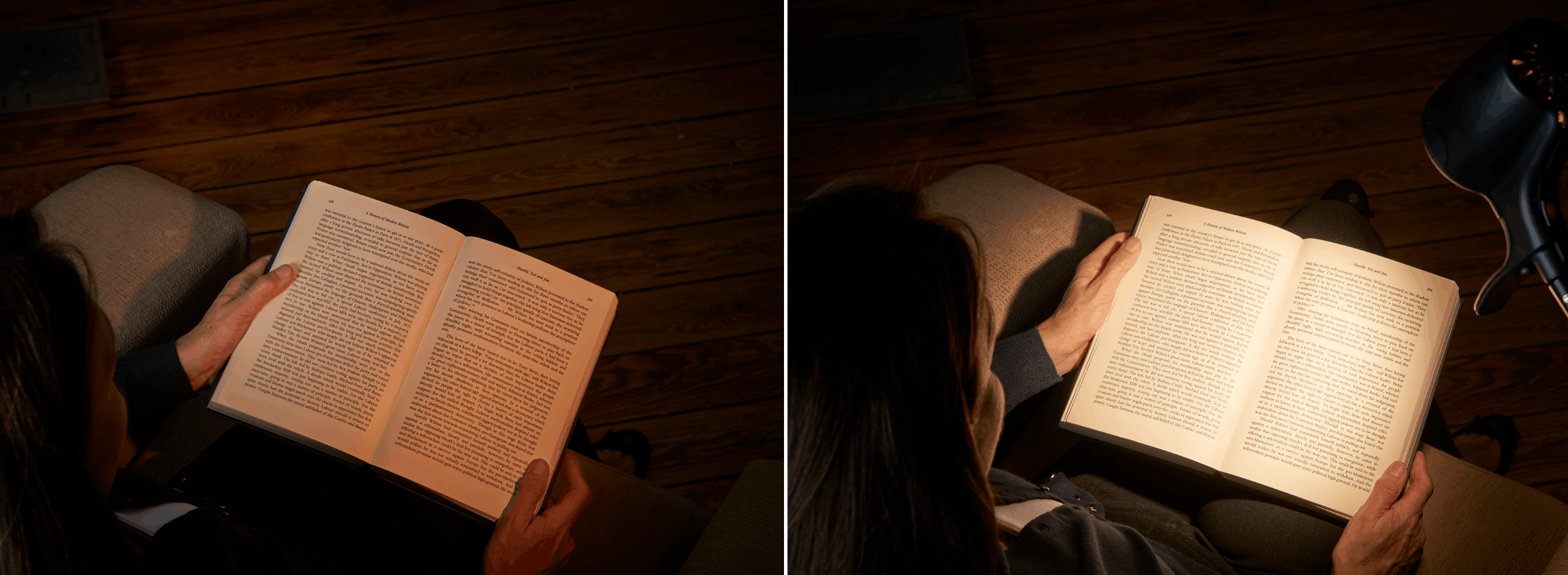
Nothing about the book changed. Only the light.
This is a photograph on a screen. On real paper, under a real lamp, the difference is bigger still.
See for yourself
Navy, or black?
One small test, and your own eyes are the judge.
Two balls of wool, two different colours. Under an ordinary bulb, can you tell them apart?
Why it happens
Three plain reasons.
1
More light reaches the page.
As a rule of thumb, the eye needs about three times as much light at sixty as it did at twenty. Most rooms are still lit for younger eyes.
2
The full spectrum of daylight.
An ordinary bulb leaves out the deep reds and blues. Daylight Wavelength Technology™ puts the whole spectrum back, so contrast returns and black reads as black.
3
The beam on the page, not the eyes.
The light is aimed down at the words where you are reading, not out across the room. You get the brightness without the glare.
There is more on the science of light and reading in our research summary.
Side by side
An ordinary lamp, and a Serious Light.
The same room, the same book. Here is what actually changes.
| An ordinary lamp | A Serious Light | |
|---|---|---|
| The spectrum | Misses the deep reds and blues | The full spectrum of daylight |
| Black on the page | Lifts to a tired grey | Reads as true black |
| Colour | Flattened, navy looks black | True, navy looks navy |
| The beam | Spills across the room | Aimed at the page, where you read |
| On the page | One dim pool | Up to twelve times a 60-watt bulb |
One more thing about light
Light is the first thing, not an afterthought.
Every living thing runs on light. Plants turn it into food, and the rest of us live off that, right down to the chemistry in our cells.
So it is strange how little thought most people give to the light they read by. And the part you can see is only half of it. Research keeps finding that light, including the wavelengths your eye never registers, plays a part in sleep, in mood, and in the body's daily clock. We make a light for reading, and a clear page is the promise we keep. The science is simply a reason to take light more seriously than most people ever do.
What they love
“It is like being given a new set of eyes. I bought my second one a week later for my husband.
Mrs Hurford, Lincolnshire · Verified review4.9 / 5
Rated on Feefo, from 11,740 verified reviews.500+
Optician practices recommend Serious Readers to their patients.90 days
Home trial on the Original and Pro, and 30 days on the rest.
Forty years on, we still make nothing but reading lights. See the difference for yourself, then read by one in your own chair before you decide. Alex Pratt OBE, Founder
Read by one in your own chair. If the page is not clearer, send it back and we collect it, free.
Or call us on 0800 032 9366.
Which light is right for you
No two pairs of eyes are the same.
A prescription that fits everyone fits nobody. So there is a range, not a single light, and each one can be set up around how and where you read.
Take the 60-second check
Answer a few questions about how and where you read. We will point you to the light that suits your eyes and your chair.
Take the Visual Comfort CheckPrefer to skip the questions?
Most readers begin with the HD Original. Full-spectrum daylight, a beam you shape around your book, and a dimmer that remembers where you left it.
See the HD OriginalThe range runs from £74.99. For something your eyes rely on every evening, for years, that is a fair price, and a good deal lower than most people expect.
Questions, answered
The things people ask first.
How does the home trial work?
Which light is right for me?
Is it actually brighter, or just different?
How is this different from a daylight bulb?
Will it help if I have an eye condition?
Do opticians really recommend it?
See it for yourself
The proof is on the page.
Most people never give the light they read by a second thought. It is worth one. For something the eyes rely on every evening, few of us would pick the cheapest and hope. Read by one yourself, in your own chair, and let your own eyes settle it.
Begin your home trial Or call us on 0800 032 9366